
Minibus vs. Charter Bus: Which Is Right for Your Group?
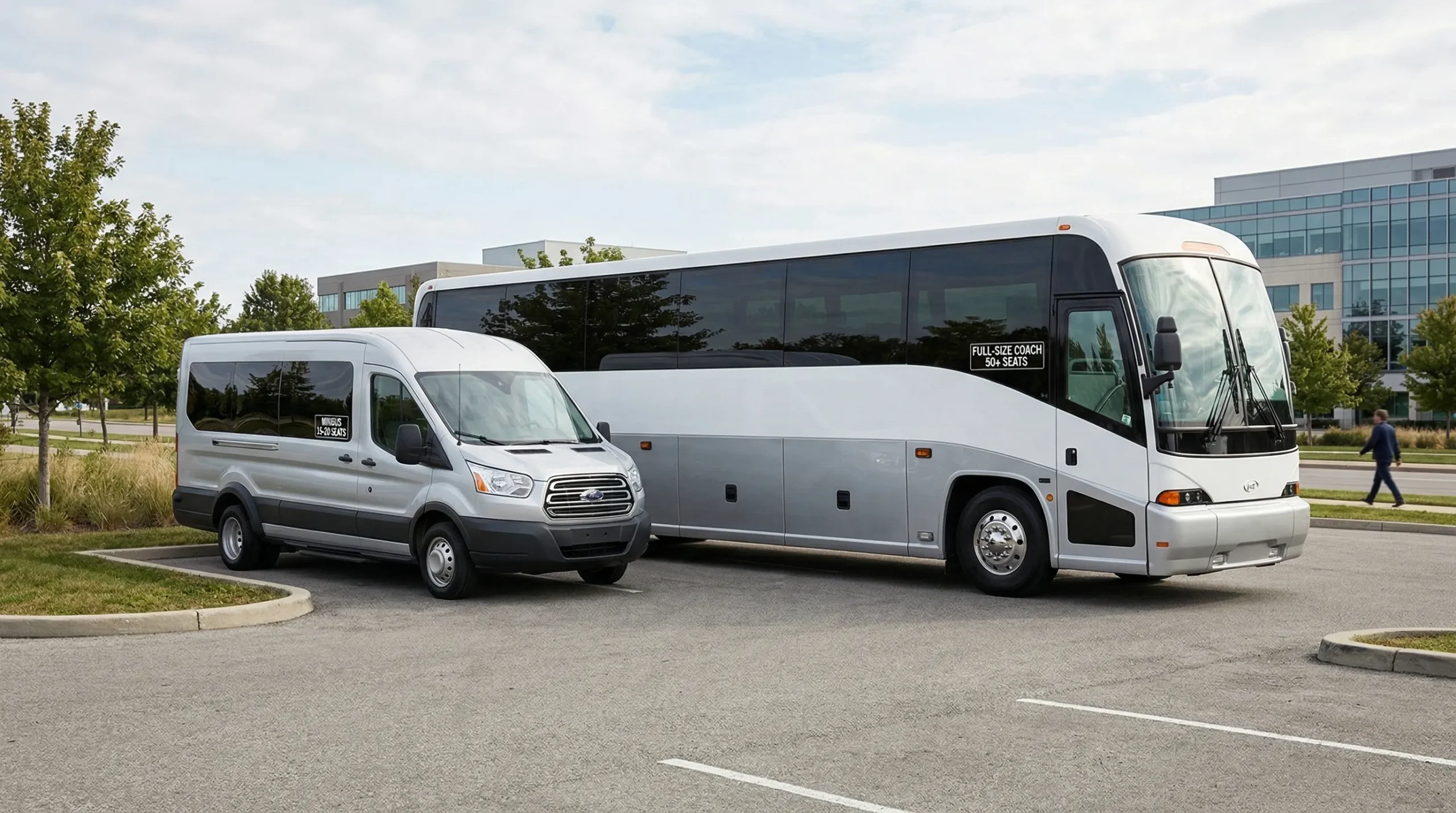
The difference between a minibus and a charter bus comes down to size, capacity, and the type of trip each vehicle is built for. A minibus typically seats 18 to 35 passengers and works well for smaller groups, shorter trips, and routes where maneuverability matters. A full-size charter bus, or motorcoach, seats up to 55 passengers and is the better choice for larger groups, longer distances, and situations where onboard comfort over several hours is a real consideration. If you’re trying to figure out which one fits your trip, here’s a practical breakdown of how the two vehicles compare across the factors that actually matter.
The Basic Difference Between a Minibus and a Charter Bus
Before getting into the specifics, it helps to understand what each vehicle actually is.
A minibus is a mid-size passenger vehicle that bridges the gap between a large van and a full-size coach. Most minibuses seat between 18 and 35 people depending on the configuration. They’re smaller, lighter, and easier to maneuver than a full motorcoach, which makes them practical for urban routes, multi-stop itineraries, and locations where parking or access for larger vehicles is limited.
A charter bus, more formally called a motorcoach, is a full-size highway coach designed for larger groups and longer journeys. Standard motorcoaches seat up to 55 passengers and are equipped with amenities designed for extended travel: reclining seats, overhead storage, climate control, WiFi, power outlets, and an onboard restroom. They’re built for comfort over distance in a way that smaller vehicles simply aren’t.
Both vehicles are professionally driven and typically chartered through the same providers. The choice between them is almost always driven by group size and trip type rather than preference.
Group Size: The Most Important Variable
If there’s one factor that determines which vehicle you need more than any other, it’s group size. Here’s a simple reference:
| Group Size | Recommended Vehicle |
| Up to 14 passengers | Sprinter van or large passenger van |
| 15 to 35 passengers | Minibus |
| 36 to 55 passengers | Full-size motorcoach |
| 56 or more passengers | Multiple vehicles |
One thing worth noting is that booking a vehicle significantly larger than your group size isn’t just inefficient on cost. It also affects the feel of the trip. A group of 20 people rattling around in a 55-passenger coach tends to feel disconnected in a way that the same group in a properly sized minibus doesn’t.
That said, if your group size is right on the border between a minibus and a motorcoach, it’s usually worth stepping up to the larger vehicle. Running out of seats because a few more people confirmed late is a worse outcome than having a handful of empty seats.
Trip Length and Comfort
Group size gets you to the right vehicle category. Trip length helps you decide whether to push toward the upper end of that category or stay with the more practical option.
For short trips under two hours, comfort over distance isn’t a major factor and a minibus handles the job well for appropriately sized groups. The seats are comfortable enough for shorter journeys, and the smaller vehicle often offers practical advantages in terms of parking and urban navigation.
For longer trips of three hours or more, the comfort gap between a minibus and a full motorcoach becomes more noticeable. Motorcoaches are designed for highway travel over extended periods. The seats recline further, there’s more legroom, overhead storage handles luggage properly, and the onboard restroom means you’re not stopping every 90 minutes. For a group spending four or five hours on the road, those differences add up.
If your trip involves an overnight journey or multi-day travel, a full-size motorcoach is almost always the right call regardless of group size, assuming your headcount justifies it.
Urban Routes vs. Highway Travel
The nature of your route matters as much as its length. A minibus has a meaningful practical advantage in dense urban environments. It’s shorter, narrower, and easier to navigate through city streets, tight turning radiuses, and parking facilities that weren’t designed with large vehicles in mind.
Consider a corporate event with multiple stops across a downtown area. A minibus can pull up to a hotel entrance, navigate to a conference venue two miles away, and park in a structure that a full motorcoach simply can’t access. For that kind of itinerary, the minibus isn’t just the more economical option, it’s the more functional one.
A full motorcoach is in its element on the highway. It’s built for sustained cruising speeds, handles well over long distances, and offers a smoother ride for passengers on extended routes. For trips that involve significant highway mileage, the motorcoach’s design advantages come through clearly.
According to the American Bus Association, motorcoaches are among the safest forms of passenger transportation in the United States, with a fatality rate significantly lower than passenger cars and comparable to commercial aviation on a per-mile basis. More information is available at buses.org.
Cost Comparison: Minibus vs. Charter Bus
As a general rule, a minibus costs less to rent than a full-size motorcoach because it’s a smaller vehicle with lower operating costs. But the more useful comparison is cost per passenger, and that calculation shifts depending on your group size.
Here’s how the math typically works:
| Vehicle | Typical Hourly Rate | Capacity | Cost Per Seat Per Hour |
| Minibus | $100 to $175 | 18 to 35 | $3 to $10 |
| Motorcoach | $125 to $250 | up to 55 | $2 to $5 |
For a full group, a motorcoach is often more cost-efficient per person than a minibus, even though its base rate is higher. For a smaller group that doesn’t fill a motorcoach, the minibus wins on total cost. This is why matching the vehicle to your actual group size is the most important cost lever you have.
Amenities: What Each Vehicle Typically Includes
Standard amenities vary somewhat by provider and vehicle age, but here’s what most groups can expect:
A minibus typically includes cushioned seating, climate control, and basic storage. Newer minibuses often include WiFi and power outlets, though this varies more than on full motorcoaches. An onboard restroom is not standard on most minibuses, which is worth factoring in for trips over 90 minutes.
A full-size motorcoach standardly includes reclining seats with more legroom, overhead luggage storage, climate control, WiFi, power outlets, and an onboard restroom. For groups interested in what modern charter buses offer beyond the basics, the overview of charter bus amenities covers features that are now common on professional vehicles.
Practical Scenarios: Which Vehicle Fits?
Sometimes the best way to make this decision concrete is to think through specific situations.
A company moving 25 employees from a downtown hotel to an offsite meeting venue across the city is a clear minibus scenario. The group fits comfortably, the urban route suits the smaller vehicle, and there’s no reason to pay for a motorcoach.
A group of 45 people traveling from Raleigh to Charlotte for a corporate conference is a clear motorcoach scenario. The group size requires it, the highway route suits it, and the three-hour journey makes onboard comfort a real consideration. For that kind of trip, bus rental Raleigh options include full-size motorcoaches available for exactly this type of corporate travel.
A wedding group of 30 guests shuttling between a ceremony venue and a reception site a few miles away sits comfortably in a minibus, with room to spare.
A technology company moving 50 employees between campuses in the Seattle metro area for an all-hands meeting needs a motorcoach. For groups in that market, charter bus rental Seattle covers both minibus and motorcoach options depending on group size and route. North American Charter Bus can help you identify the right vehicle for your specific trip across both vehicle categories.
Frequently Asked Questions
Size and capacity. A minibus seats 18 to 35 passengers and is suited for smaller groups and shorter or urban routes. A charter bus, or motorcoach, seats up to 55 passengers and is designed for larger groups and longer journeys with full onboard amenities.
The base hourly rate for a minibus is typically lower than a motorcoach. However, on a per-passenger basis, a full motorcoach with a complete group is often more cost-efficient. The right comparison depends on your group size and how many seats you’re actually filling.
Most minibuses do not have an onboard restroom as standard. If your trip is longer than 90 minutes, this is worth factoring into your vehicle choice or your planning for rest stops along the route.
Yes. Most charter bus providers and network brokers offer both vehicle types. If your event requires a mix of vehicle sizes, a single provider can often coordinate both under one booking.
Start with your group size and match it to the capacity table above. Then consider your route: urban and multi-stop trips favor a minibus, highway and longer journeys favor a motorcoach. If you’re on the border between the two, the longer or more comfort-sensitive the trip, the more the motorcoach makes sense.
Ready to Book the Right Vehicle?
Whether your group fits a minibus or needs a full motorcoach, getting a quote with your specific trip details gives you a real number to work with. North American Charter Bus works with groups of all sizes to match them with the right vehicle for their route, schedule, and budget.