
How to Plan Group Transportation for a Large Corporate Event
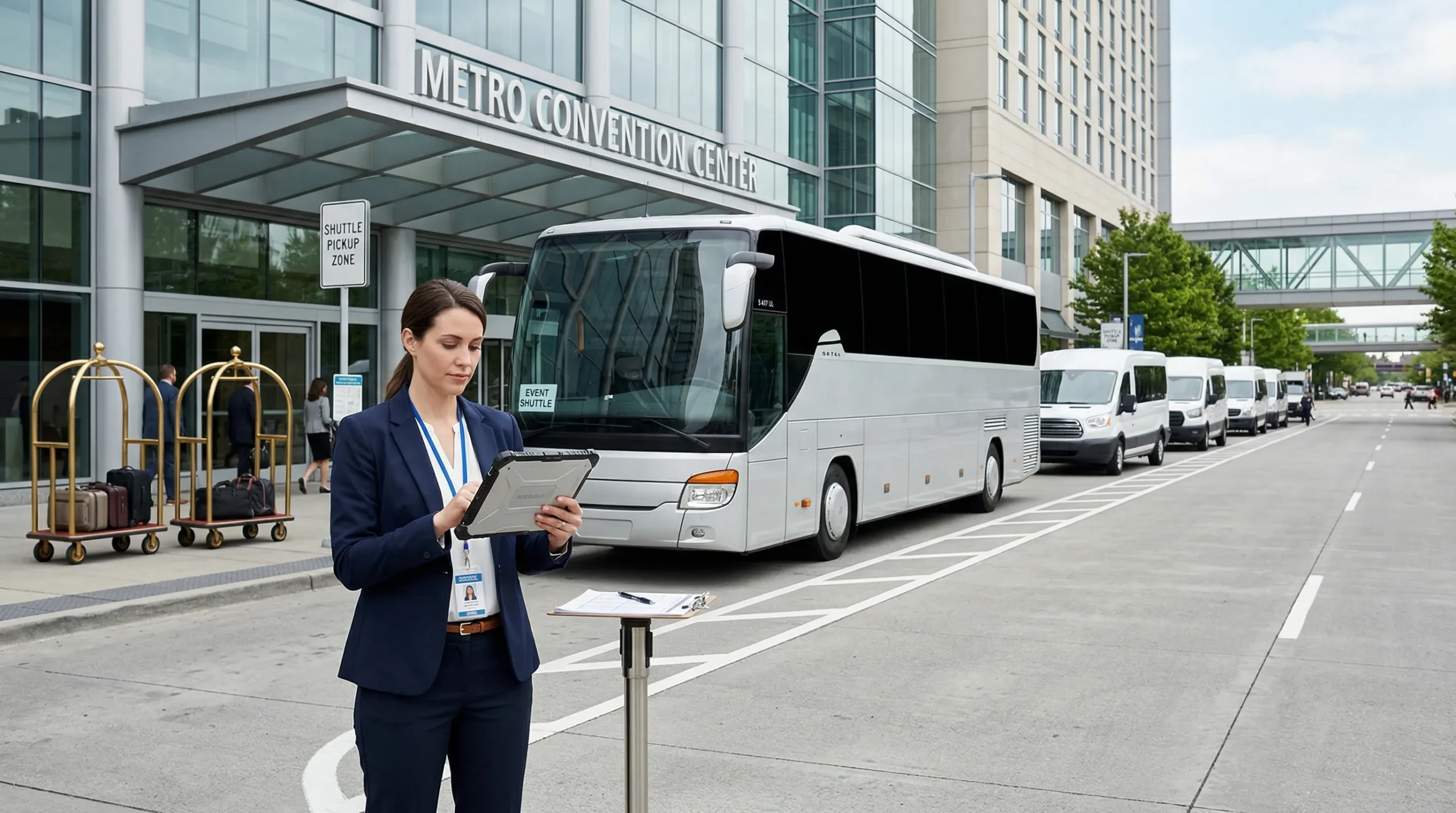
Planning group transportation for a large corporate event is a logistics exercise that rewards early preparation and punishes last-minute improvisation. The core challenge isn’t finding a bus. It’s building a transportation program that accounts for every movement your attendees need to make, matches the right vehicles to each transfer, and holds together reliably on the day when everything is happening at once. Whether you’re coordinating transportation for a 100-person offsite or a 500-person national conference, the planning process follows the same fundamental steps. Here’s how to do it right.
Step One: Map Every Movement Before You Think About Vehicles
The first thing to get on paper is a complete movement map for your event. This is a full list of every transfer your attendees need to make from the moment they arrive in the city to the moment they leave.
For a typical multi-day corporate conference, that list might include airport arrivals on day one, hotel to venue transfers each morning, venue to lunch location runs, afternoon session returns, evening dinner or networking event shuttles, and airport departures on the final day. Each of those movements is a separate transportation need with its own timing, headcount, and route.
Most transportation planning mistakes happen because planners start thinking about vehicles before they have the full movement map in front of them. A vehicle count that looks right for the main conference shuttle can look completely wrong once you add in the airport runs, the offsite dinner, and the late-night returns.
Get the complete picture first. Everything else flows from there.
Step Two: Estimate Realistic Headcounts for Each Transfer
Once you have your movement map, the next task is attaching realistic headcount estimates to each transfer. Note the word realistic, because confirmed registration numbers are rarely the same as actual shuttle ridership.
A useful working assumption for most corporate events is that 70 to 80 percent of attendees will use a provided shuttle for any given transfer. Some people will have rental cars. Some will walk if the venue is close. Some will share rideshares with colleagues regardless of what shuttle is available. Planning your vehicle capacity for 100 percent shuttle ridership on every run leads to over-provisioning that adds unnecessary cost.
That said, certain transfers warrant higher capacity planning. Airport arrivals and departures tend to have higher shuttle usage rates because attendees in an unfamiliar city with luggage are more likely to take the provided option. End-of-night returns from dinner events also tend to have high ridership. Know which transfers are likely to draw your full group and size those accordingly.
Step Three: Match Vehicles to Each Transfer
With a movement map and realistic headcounts in hand, you can now make intelligent decisions about vehicle type and count for each transfer rather than guessing.
The basic framework is straightforward. Groups of 15 to 35 people fit a minibus. Groups of 36 to 55 need a full-size motorcoach. Groups larger than 55 need multiple vehicles or staggered runs. But beyond raw capacity, the nature of each transfer should influence your vehicle choice.
Urban transfers with multiple stops or tight parking situations favor a minibus even if your group could technically fit a motorcoach. Highway transfers of two hours or more favor a motorcoach for comfort reasons even if a minibus has enough seats. Airport transfers with significant luggage benefit from a motorcoach’s overhead storage capacity.
For groups evaluating specific vehicle options in detail, the comparison of minibus vs charter bus options covers the practical differences between vehicle types across different trip scenarios. Getting vehicle selection right at this stage prevents both overspending on capacity you don’t need and underdelivering on comfort for transfers that warrant a better vehicle.
Step Four: Build a Realistic Schedule With Buffer Time
A transportation schedule that has no margin for error will encounter errors and fail. Real events involve flight delays, sessions that run long, venue loading that takes longer than expected, and the general unpredictability of moving large groups of people.
Build 15 to 20 minutes of buffer into every transfer in your schedule. For airport pickups, build more. A flight arriving at the scheduled time is the optimistic scenario. Plan for the realistic one.
Think about your transfers in waves rather than single departure events wherever possible. A hotel checkout shuttle on the final morning of a conference doesn’t need to move everyone simultaneously. Three staggered departures 20 minutes apart are operationally smoother than one massive departure that requires perfect coordination across hundreds of people.
For events that involve coordinating travel for sports teams or large athletic groups, the guide on how to book a charter bus for sports teams offers useful practical context on managing group departures that applies directly to corporate travel planning.
Step Five: Request Quotes and Choose a Provider
With your movement map, headcounts, vehicle requirements, and schedule drafted, you now have everything a provider needs to give you an accurate quote. This is the right time to reach out, not before.
When evaluating providers, a few things are worth specific attention beyond price. Ask about backup protocols: what happens if a vehicle has a mechanical issue on the day of your event? Ask about driver communication: will you have a direct contact number for each driver, or does everything go through a dispatch line? Ask about their experience with events of similar size and complexity.
For large corporate events requiring multiple vehicles across several days, a network-based provider offers advantages that a single local operator typically can’t match. Access to multiple vehicle types, broader carrier availability during peak periods, and the ability to coordinate across cities if your event spans multiple locations are all meaningful operational advantages.
According to the Convention Industry Council, event-related ground transportation accounts for a significant share of total event logistics budgets, with larger conferences often spending as much on transportation as on audiovisual production. More data is available at eventscouncil.org.
For events on the East Coast, bus rental Raleigh services cover multi-vehicle corporate programs across the Southeast. For events in Texas, charter bus rental San Antonio options include full conference transportation coordination across the region. North American Charter Bus works with corporate event planners nationally to coordinate transportation programs across a vetted carrier network.
Step Six: Communicate the Plan to Attendees
A well-designed transportation program that attendees don’t understand or can’t find information about delivers a fraction of its potential value. Communication is the final operational step and one that’s easy to underinvest in when you’re managing a dozen other event logistics simultaneously.
At minimum, every attendee should receive a clear transportation summary before the event that includes pickup locations with specific addresses, departure times for each run, and a contact number for day-of transportation questions. For multi-day events, a brief daily update keeps people oriented as the schedule evolves.
On-site signage at every pickup location matters more than most planners expect. A clearly marked shuttle pickup area with visible departure times eliminates a significant portion of the attendee questions your team will otherwise field throughout the day.
Designate a single on-site transportation coordinator who owns communication with drivers and can make real-time adjustments if a transfer runs late or a headcount changes unexpectedly. That person should have direct contact information for every driver and a clear escalation path if something goes wrong.
A Timeline for Getting This Done
Here’s a practical planning timeline for most large corporate events:
Eight to ten weeks out: complete your movement map and headcount estimates. Begin requesting quotes from providers.
Six to eight weeks out: select your provider, sign the contract, and pay the deposit. Confirm vehicle types and preliminary schedule.
Three to four weeks out: finalize headcounts, confirm the full schedule with your provider, and share the transportation plan with your internal event team.
One to two weeks out: confirm all pickup addresses, driver contact information, and day-of logistics with the provider. Distribute the attendee transportation guide.
Day of event: brief your on-site transportation coordinator, confirm vehicle arrivals, and monitor the first few transfers closely before stepping back.
Frequently Asked Questions
Eight to ten weeks out is a reliable starting point for most large events. For conferences requiring many vehicles during peak seasons, starting earlier gives you better availability and more competitive pricing.
Plan your vehicle capacity assuming 70 to 80 percent shuttle ridership rather than 100 percent. For attendees who opt out, have a clear alternative recommendation ready, whether that’s a recommended rideshare option or a taxi stand location.
Stagger your shuttle runs to align with the main arrival windows rather than trying to consolidate everyone into a single pickup. Assign a greeter at the arrivals area with clear signage and direct contact with the shuttle driver.
One provider simplifies communication and accountability significantly. For large multi-vehicle events, a network-based provider can handle the full program without requiring you to manage multiple vendor relationships.
This is why backup protocols matter. Ask your provider before the event how they handle vehicle or driver failures. A network-based provider with access to multiple carriers is better positioned to source a replacement quickly than a single-operator company.
Ready to Start Planning?
The earlier you begin the transportation planning process, the more options you have and the smoother the execution tends to be. North American Charter Bus works with corporate event planners nationally to build group transportation programs that fit the specific logistics of each event, from small offsites to large multi-day conferences.