
Employee Transportation for Hospitals and Healthcare Campuses
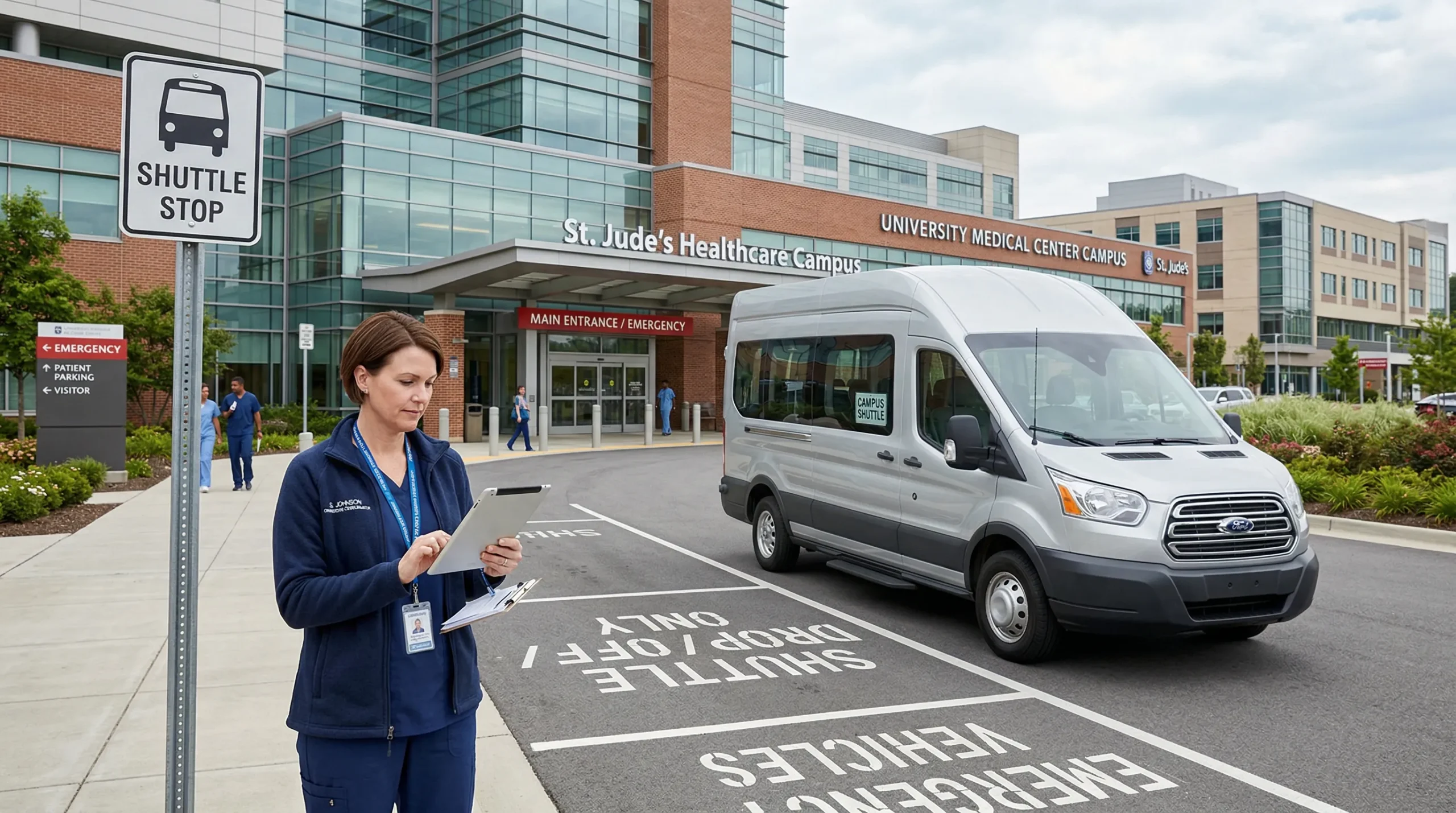
Hospital employee shuttle services are contracted transportation programs that move healthcare staff between parking facilities, transit hubs, and medical campuses on a fixed or semi-fixed schedule. For large healthcare systems with multiple buildings, shift-based staffing, and around-the-clock operations, a dedicated shuttle program is often the most reliable and cost-effective way to keep staff moving between locations without adding friction to an already demanding work environment. If you’re responsible for employee transportation at a hospital or healthcare campus, here’s what you need to know.
Why Healthcare Facilities Have Unique Transportation Needs
Hospitals don’t run like office buildings. A corporate campus with standard business hours has predictable transportation demand that peaks in the morning and evening and goes quiet in between. A hospital runs 24 hours a day, seven days a week, with shift changes happening at irregular intervals and staff numbers fluctuating based on patient volume, seasonal demand, and departmental schedules.
That complexity makes off-the-shelf transportation solutions a poor fit. Rideshare platforms work reasonably well for one-off trips, but they don’t scale reliably across rotating shifts and unpredictable demand patterns. Public transit covers some routes in some cities, but it rarely aligns precisely with the shift times and facility locations that healthcare workers actually need.
A contracted shuttle program built around your facility’s specific schedule and geography fills that gap. It’s predictable, scalable, and can be adjusted as operational needs change.
The Parking Problem Most Healthcare Campuses Share
Parking is one of the most persistent operational headaches for large medical campuses. Facilities built over decades often have parking infrastructure that hasn’t kept pace with staff growth. Land in urban and suburban healthcare corridors is expensive, and building new parking structures is a significant capital investment.
The practical result is that many hospitals rely on remote parking facilities, leased lots, or park-and-ride arrangements that put staff anywhere from a short walk to several miles away from their building. Without a reliable shuttle connecting those facilities to the campus, staff are left to manage the gap themselves, which creates tardiness issues, adds commute stress, and makes the facility less attractive as an employer.
A shuttle program that reliably connects remote parking to the campus entrance solves this problem directly. Staff park, board, and arrive on time without the uncertainty of navigating a parking situation on their own.
Shift-Based Scheduling: Building a Program That Actually Works
The biggest operational challenge in designing a healthcare employee shuttle program is matching the vehicle schedule to the actual shift pattern rather than a simplified approximation of it.
Consider a large regional hospital with nursing shifts changing at 7am, 3pm, and 11pm, administrative staff arriving between 8am and 9am, and a separate medical office building with its own schedule running 8am to 5pm on weekdays. A single shuttle route on a fixed loop won’t serve all of those populations well. A well-designed program maps each significant shift change to a corresponding shuttle run, with vehicle size matched to expected ridership at each time.
This is where working with an experienced provider matters. A charter bus company that has set up healthcare shuttle programs before understands how to structure routes and schedules around shift complexity rather than treating every client like a standard commuter program.
According to the American Hospital Association, the United States has more than 6,100 hospitals employing millions of healthcare workers across facilities that range from small community hospitals to large academic medical centers. More data on the healthcare workforce is available at aha.org.
Multi-Campus Transportation: Moving Staff Between Facilities
Large healthcare systems often operate multiple campuses, specialty centers, and affiliated clinics spread across a metro area. Staff who work across locations, physicians who rotate between facilities, and administrative teams split across buildings all need reliable inter-campus transportation.
This is an area where charter buses and minibuses offer a real operational advantage. A contracted inter-campus shuttle running on a defined schedule eliminates the need for staff to drive between facilities, deal with parking at each location, and absorb the time and stress of managing their own transit between appointments and shifts.
For healthcare systems with campuses in multiple cities, providers with national networks can coordinate transportation across locations without requiring separate vendor relationships in each market. North American Charter Bus works with organizations that need consistent group transportation across multiple locations and can coordinate vehicles across a broad carrier network.
What to Look for in a Healthcare Shuttle Provider
Not every charter bus company is equipped to handle the specific demands of a healthcare transportation program. Here’s what matters most when evaluating providers:
24-hour availability. Your shuttle program needs to cover early morning, late night, and overnight shifts. Confirm that your provider can staff drivers and vehicles across all required time windows, not just standard business hours.
Schedule reliability. In a healthcare environment, a shuttle that runs late has real operational consequences. Ask providers about their on-time performance track record and what backup protocols they have when a vehicle or driver is unavailable.
Accessibility. Healthcare facilities serve employees with a wide range of physical needs. Confirm that vehicles in the program meet ADA accessibility requirements where applicable.
Flexible contract terms. Healthcare staffing levels change. A good provider will build reasonable flexibility into the contract to accommodate changes in ridership, route adjustments, and schedule modifications.
Professional drivers. The driver is the face of your transportation program. Professionalism, punctuality, and familiarity with the route are baseline requirements.
Connecting Remote Staff and Transit-Dependent Employees
In cities with strong public transit networks, many healthcare workers commute by train or bus and need a reliable connection from the transit station to the medical campus. A shuttle that runs a predictable loop between the nearest transit hub and the facility entrance makes it possible for staff to use public transit for the main portion of their commute without worrying about the last mile.
This is particularly relevant for facilities in cities like Seattle, where public transit use is high and the connection between transit stations and medical campuses isn’t always straightforward. For healthcare organizations in the Pacific Northwest, charter bus rental Seattle options include shuttle programs designed around transit connections and medical campus routes.
For facilities in the Research Triangle area, where healthcare is one of the region’s largest employment sectors, bus rental Raleigh services cover both campus shuttle programs and inter-facility transportation needs.
Frequently Asked Questions
A hospital employee shuttle is a contracted transportation program that moves healthcare staff between parking facilities, transit hubs, and medical campus buildings on a fixed schedule. It’s designed to handle the shift-based, around-the-clock transportation needs of large healthcare facilities.
Costs depend on the number of routes, daily runs, vehicle sizes, and hours of operation. A basic program covering peak shift changes with a single minibus might run $400 to $900 per day. Larger programs with multiple vehicles and extended hours will cost more. A quote based on your specific schedule and route structure gives you the most useful number.
Yes. Professional charter bus providers can build programs around any shift pattern, including overnight runs, weekend schedules, and rotating shifts. Be specific about your full schedule when requesting a quote.
Most providers can adjust vehicle sizes and run frequencies as ridership changes. Build flexibility into your contract terms from the start and discuss how schedule or route modifications are handled before you sign.
It depends on ridership at each shift change. A minibus works well for smaller shift populations of 18 to 35 staff. A full-size motorcoach handles up to 55. Programs with variable ridership across shifts sometimes use different vehicle sizes for different runs.
Ready to Build a Transportation Program for Your Facility?
If you’re managing employee transportation for a hospital or healthcare campus, getting a quote based on your specific schedule and route structure is the most useful first step. North American Charter Bus works with healthcare organizations to build shuttle programs that match the operational complexity of large medical facilities.