
Employee Shuttle Bus vs. Rideshare for Companies: A Cost and Logistics Comparison
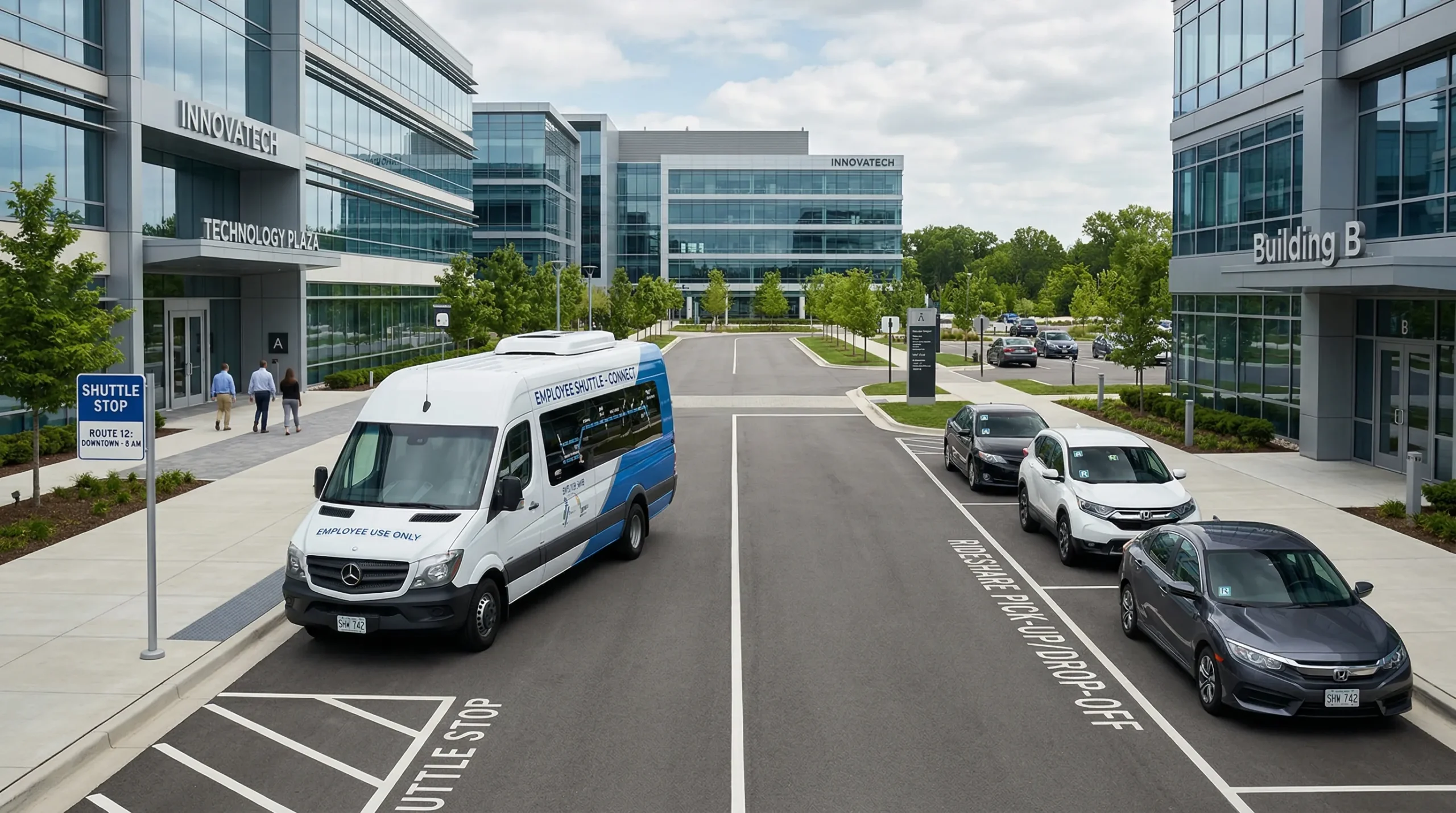
For companies managing regular employee transportation, the choice between a dedicated shuttle bus service and rideshare platforms like Uber or Lyft comes down to more than just cost per trip. Group size, trip frequency, predictability, and the overall employee experience all factor into which option actually makes sense for your organization. The short answer is that rideshare works well for occasional, small-group travel, while a dedicated employee shuttle service almost always wins on cost and reliability once your daily transportation needs reach a certain scale. Here’s how the two options compare across the factors that matter most.
What Each Option Actually Involves
Before getting into the numbers, it’s worth being clear about what each model looks like in practice.
A rideshare program means employees use platforms like Uber, Lyft, or similar services to travel between home, work, or other locations, with the company either reimbursing costs or managing a corporate account. It’s flexible and requires no advance vehicle planning, but it offers very little control over cost, timing, or experience at scale.
A dedicated employee shuttle service means contracting a charter bus or minibus to run fixed or semi-fixed routes on a consistent schedule. The company pays a predictable rate for the vehicle, and employees board and depart on a set timetable. It requires more upfront planning but becomes significantly more cost-efficient as group size and trip frequency increase.
The Cost Comparison: Where the Numbers Actually Land
This is where the difference becomes stark for most companies. Rideshare costs scale linearly with the number of employees using the service. Every additional rider is an additional fare, and surge pricing during peak commute hours can push individual trip costs well above the baseline rate.
Let’s say a company needs to transport 40 employees from a central meeting point to an offsite location 20 miles away. At an average rideshare fare of $25 to $35 per trip per person, that’s $1,000 to $1,400 for a single one-way journey, before surge pricing. A charter bus for the same trip would typically cost $400 to $700 depending on the market and vehicle type.
For daily commuter shuttle programs, the gap widens further. A company running a shuttle route five days a week with consistent ridership is almost always better off financially with a contracted shuttle service than with an open rideshare tab.
According to the Global Business Travel Association, ground transportation consistently ranks among the top three corporate travel expense categories for mid-size and large companies. You can find more data on corporate travel trends at gbta.org.
Reliability and Scheduling: A Real Operational Difference
Rideshare platforms are convenient, but they’re not built for precision at scale. During high-demand periods, wait times stretch, drivers cancel, and the promise of a 7-minute pickup can quickly become a 25-minute delay. For companies with shift-based workforces, tight event schedules, or employees traveling between campuses on a fixed timetable, that unpredictability is a genuine operational problem.
A dedicated shuttle service runs on your schedule. The vehicle is reserved for your group, the driver knows the route, and the departure time doesn’t shift because surge demand spiked in your zip code. For construction site shuttles, hospital employee transportation, or corporate campuses with fixed shift changes, this kind of reliability isn’t just convenient — it’s operationally necessary.
The Employee Experience Factor
It’s easy to underestimate how much transportation quality affects employee satisfaction, but companies with distributed workforces or difficult commutes know it matters. A comfortable, reliable shuttle reduces commute stress, gives employees time to decompress or prepare before arriving, and signals that the company takes their time seriously.
Rideshare experiences vary widely. A good driver and a clean vehicle on one trip can be followed by a cancellation and a long wait the next. For employees using company-arranged transportation regularly, that inconsistency adds up.
For corporate groups interested in what modern charter buses actually offer in terms of comfort and amenities, it’s worth reading about charter bus amenities that have become standard on professional vehicles.
When Rideshare Still Makes Sense
Rideshare isn’t the wrong answer in every situation. For companies with small teams, irregular schedules, or one-off travel needs, the flexibility of rideshare outweighs the cost efficiency of a dedicated vehicle. If you’re moving two or three employees to an airport at different times on different days, a rideshare account is the practical choice.
The tipping point for most companies tends to be around 10 to 15 employees traveling the same route at the same time on a regular basis. Below that threshold, rideshare often wins on simplicity. Above it, a dedicated shuttle service typically wins on everything else.
Applying This to Specific Use Cases
Construction sites. Large construction projects often involve workers traveling from a central staging area to a job site, sometimes across significant distances. A contracted shuttle handles this efficiently and keeps crews arriving together and on time. North American Charter Bus offers construction site shuttle services for exactly this kind of recurring, route-based transportation need.
Hospitals and healthcare campuses. Healthcare facilities with multiple buildings or campuses, shift-based staffing, and 24-hour operations need transportation solutions that match that complexity. Rideshare doesn’t scale well across rotating shifts and unpredictable demand patterns. A contracted shuttle program, even a partial one covering peak shift changes, tends to perform better.
Corporate offices and tech campuses. Companies with employees commuting from transit hubs or parking facilities benefit from the consistency and capacity of a dedicated shuttle. It’s a model that major employers have used for years, and it scales well as headcount grows.
If you’re evaluating group transportation options for your company, North American Charter Bus works with businesses across industries to build employee transportation programs that fit their specific operational needs.
Making the Decision for Your Company
The right framework is simple. Start with your numbers: how many employees need transportation, how often, over what distance, and at what times. Run the rideshare cost at scale and compare it against a charter bus or minibus quote for the same trips. In most cases where group size and frequency are significant, the shuttle wins on cost before you even factor in reliability and employee experience.
For companies in cities with active charter bus markets, getting a quote is easy and gives you a concrete comparison point. If your team is based in the Pacific Northwest, charter bus rental Seattle options are available for corporate shuttle programs of all sizes.
Frequently Asked Questions
For most companies, a dedicated shuttle becomes more cost-effective once you’re regularly moving 10 or more employees along the same route at the same time. The exact tipping point depends on your market, trip distance, and rideshare rates in your area.
Yes. Many charter bus providers offer contracted shuttle programs designed specifically for recurring corporate transportation needs, including daily commuter routes, shift-change transfers, and campus connectors.
Costs vary by market, vehicle type, and route length. A minibus running a daily corporate shuttle route might cost anywhere from $300 to $1,000 per day depending on distance and location. Getting a quote based on your specific route and schedule gives you the most accurate number.
For groups of 10 or more traveling to or from an airport together, a charter bus or minibus is almost always more cost-effective and logistically simpler than coordinating multiple rideshare vehicles.
Yes. Many providers can build schedules around shift patterns, including early morning, late night, or rotating routes. It’s worth discussing your specific schedule requirements when requesting a quote.
Ready to Compare Your Options?
If you’re weighing employee transportation options for your company, getting a charter bus quote gives you a real number to work with. North American Charter Bus works with businesses across industries to match them with the right vehicles and carriers for their transportation needs.